
Scroll saw blade chart: sizes, teeth per inch and speeds
What a scroll saw blade number means in teeth per inch, which stock each size suits, what the blade types do, and how fast saw makers say to run them.
Printable version (one page, PDF)Embed or download (free, CC BY 4.0)
Embed or download this chart
Free for classes, shops, clubs and blogs under CC BY 4.0: use, print and share it; credit Woodworking Math with a link. The embed always shows the current numbers and where they come from.
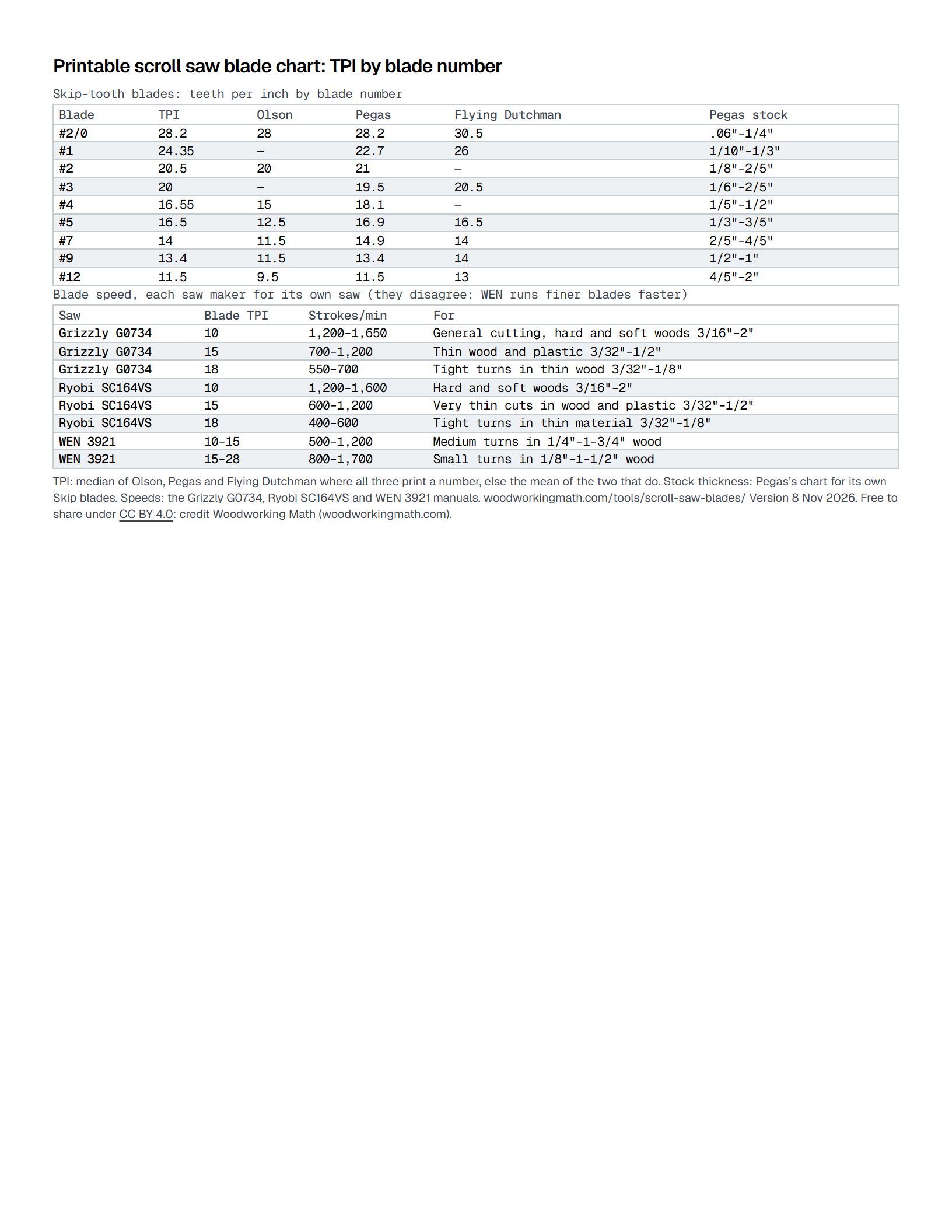
Blade numbers and teeth per inch
A blade number is not a standard: each maker sets its own teeth per inch (TPI) for a number. Olson’s #5 skip-tooth blade has 12.5 TPI, where Pegas’s has 16.9 and Flying Dutchman’s 16.5. So each maker is shown beside the median, or beside the mean of the two that print a number. A number only one maker prints is left out. The stock range is Pegas’s, for its own Skip blades.
| Blade | TPI | Olson | Pegas | Flying Dutchman | Pegas stock | Sources |
|---|---|---|---|---|---|---|
| #2/0 | 28.2 | 28 | 28.2 | 30.5 | .06"–1/4" (1.5–6 mm) | Median of 3 sources |
| #1 | 24.35 | — | 22.7 | 26 | 1/10"–1/3" (2.5–8 mm) | Only two sources publish this: Pegas and Flying Dutchman (Mike’s Workshop) |
| #2 | 20.5 | 20 | 21 | — | 1/8"–2/5" (3–10 mm) | Only two sources publish this: Olson Saw and Pegas |
| #3 | 20 | — | 19.5 | 20.5 | 1/6"–2/5" (4–10 mm) | Only two sources publish this: Pegas and Flying Dutchman (Mike’s Workshop) |
| #4 | 16.55 | 15 | 18.1 | — | 1/5"–1/2" (5–12 mm) | Only two sources publish this: Olson Saw and Pegas |
| #5 | 16.5 | 12.5 | 16.9 | 16.5 | 1/3"–3/5" (8–15 mm) | Median of 3 sources |
| #7 | 14 | 11.5 | 14.9 | 14 | 2/5"–4/5" (10–20 mm) | Median of 3 sources |
| #9 | 13.4 | 11.5 | 13.4 | 14 | 1/2"–1" (12–25 mm) | Median of 3 sources |
| #12 | 11.5 | 9.5 | 11.5 | 13 | 4/5"–2" (20–50 mm) | Median of 3 sources |
Read 2026-11-08: Olson Saw, Scroll saw blade selection chart (2020): skip, double tooth, reverse, spiral and pin-end blades; Pegas, Scroll sawblade selection chart: Skip, Skip Reverse, Double Skip and Spiral, with stock thickness; Flying Dutchman (Mike’s Workshop), Polar scroll saw blades: TPI by blade number.
Blade types
Skip-tooth, double-tooth, reverse-tooth and spiral blades, and pin-end against plain-end. The makers disagree on double-tooth blades, so both sides are given.
Blade numbers run fine to coarse: a lower number is narrower with more teeth, for thin stock and tight turns; a higher number is for thicker stock.
Scroll saw blades are 5" (about 130 mm) long.
Skip-tooth blades are the general-purpose blade.
Blades with reverse teeth have a few teeth at the bottom pointing up; they cut on the upstroke and stop splintering on the underside of the work.
Olson sets its reverse-tooth blades so 1–2 reverse teeth show above the table on the upstroke.
One source: Olson Saw, the maker of those blades , sources [1]
Flying Dutchman warns that too many reverse teeth can burn the wood.
One source: Flying Dutchman (Mike’s Workshop), the maker of those blades , sources [3]
Double-tooth blades suit hard wood.
Two sources: Olson Saw and Flying Dutchman (Mike’s Workshop) , sources [1, 3]
Pegas calls its double-skip blades excellent for soft woods, saying the wider gaps clear the chips and stop the wood burning.
One source: Pegas, the maker of those blades , sources [2]
Spiral blades have teeth all the way round, so they cut in any direction without turning the work.
Pegas says its spiral blades leave a rough finish.
One source: Pegas, the maker of those blades , sources [2]
Blades are pin-end (a cross pin at each end) or plain end (no pins); a saw takes the kind its blade holders are made for, or the other with adapters.
Fit the blade with its teeth pointing down, toward the table.
Feed evenly and let the blade do the cutting rather than forcing it.
Sources
- Olson Saw, Scroll saw blade selection chart (2020): skip, double tooth, reverse, spiral and pin-end blades, read 2026-11-08
- Pegas, Scroll sawblade selection chart: Skip, Skip Reverse, Double Skip and Spiral, with stock thickness, read 2026-11-08
- Flying Dutchman (Mike’s Workshop), Choosing a blade, read 2026-11-08
- Flying Dutchman (Mike’s Workshop), Polar scroll saw blades: TPI by blade number, read 2026-11-08
- WEN, 3921 16" variable speed scroll saw manual (2023-12-15): blade selection, p. 12, read 2026-11-08
- Grizzly Industrial, Model G0734/G0735 16" scroll saw owner’s manual (mfd. since 12/15): blade speed and selection, pp. 22–24, read 2026-11-08
Blade speed
Saw makers give speed in strokes per minute (SPM) by blade, each for its own saw. Grizzly and Ryobi run finer blades and thinner stock slower. WEN runs its finer blades faster. They disagree, so no single speed is given: start from your own saw’s manual.
| Blade TPI | SPM | For |
|---|---|---|
| 10 | 1,200–1,650 | General cutting, hard and soft woods 3/16"–2" |
| 15 | 700–1,200 | Thin wood and plastic 3/32"–1/2" |
| 18 | 550–700 | Tight turns in thin wood 3/32"–1/8" |
| Blade TPI | SPM | For |
|---|---|---|
| 10 | 1,200–1,600 | Hard and soft woods 3/16"–2" |
| 15 | 600–1,200 | Very thin cuts in wood and plastic 3/32"–1/2" |
| 18 | 400–600 | Tight turns in thin material 3/32"–1/8" |
| Blade TPI | SPM | For |
|---|---|---|
| 10–15 | 500–1,200 | Medium turns in 1/4"–1-3/4" wood |
| 15–28 | 800–1,700 | Small turns in 1/8"–1-1/2" wood |
Read 2026-11-08, each maker for its own saw: Grizzly Industrial, Model G0734/G0735 16" scroll saw owner’s manual (mfd. since 12/15): blade speed and selection, pp. 22–24; Ryobi, SC164VS scroll saw operator’s manual: choice of blade and speed; WEN, 3921 16" variable speed scroll saw manual (2023-12-15): blade selection, p. 12.