
Sandpaper grit chart
A grit number names the average size of the abrasive particles: the higher the number, the smaller the particles and the finer the scratch. There are two numbering scales in woodworking shops. P grades are the European FEPA scale; plain numbers are usually the US CAMI scale, as Klingspor explains. This chart gives both in microns, from three abrasive makers’ grading tables, and then which grit finish makers use for which job.
Printable version (one page, PDF)Embed or download (free, CC BY 4.0)
Embed or download this chart
Free for classes, shops, clubs and blogs under CC BY 4.0: use, print and share it; credit Woodworking Math with a link. The embed always shows the current numbers and where they come from.
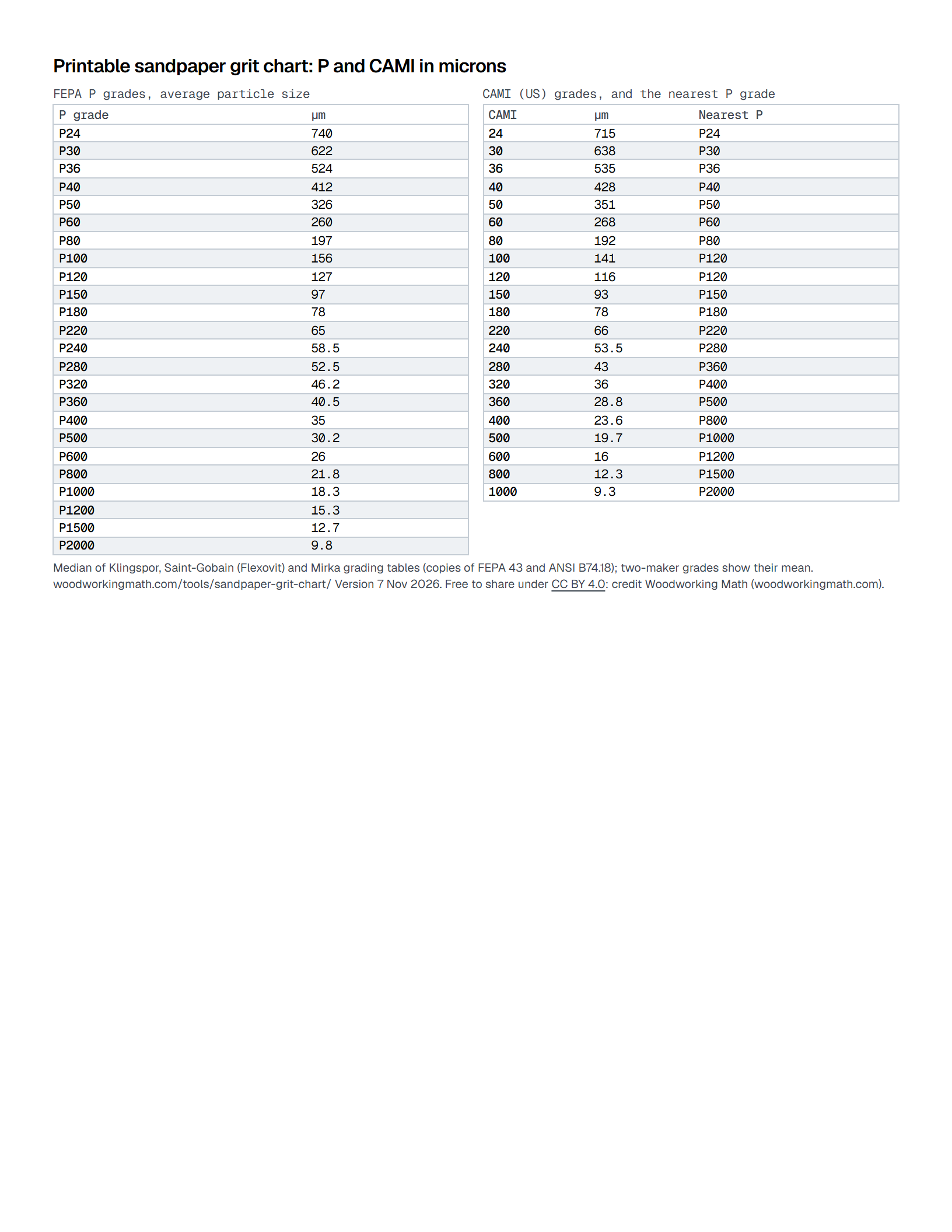
P and CAMI grits in microns
Each size is the median of what Klingspor, Saint-Gobain and Mirka print for the grade, with the span when they differ. Klingspor and Saint-Gobain print the older FEPA figures, Mirka rounded figures closer to the current edition, so the span shows the gap. A grade only one maker lists is left out. Up to about 180 the two scales match closely (P80 is 197 µm); finer than that, a P number is higher than the CAMI number for the same particle size: CAMI 400 is about P800.
| Grade | Average µm | Makers’ span | Sources |
|---|---|---|---|
| P24 | 740 | Only two sources publish this: Klingspor and Saint-Gobain Abrasives | |
| P30 | 622 | 622–622 | Only two sources publish this: Klingspor and Saint-Gobain Abrasives |
| P36 | 524 | 500–524 | Median of 3 sources |
| P40 | 412 | 412–425 | Median of 3 sources |
| P50 | 326 | 326–336 | Median of 3 sources |
| P60 | 260 | 260–270 | Median of 3 sources |
| P80 | 197 | 197–200 | Median of 3 sources |
| P100 | 156 | 156–162 | Median of 3 sources |
| P120 | 127 | 125–127 | Median of 3 sources |
| P150 | 97 | 97–100 | Median of 3 sources |
| P180 | 78 | 78–82 | Median of 3 sources |
| P220 | 65 | 60.5–68 | Median of 3 sources |
| P240 | 58.5 | 58.5–60 | Median of 3 sources |
| P280 | 52.5 | 52–52.5 | Median of 3 sources |
| P320 | 46.2 | 46–46.2 | Median of 3 sources |
| P360 | 40.5 | 40–40.5 | Median of 3 sources |
| P400 | 35 | Median of 3 sources | |
| P500 | 30.2 | 30–30.2 | Median of 3 sources |
| P600 | 26 | 25.8–27.8 | Median of 3 sources |
| P800 | 21.8 | 21.8–22 | Median of 3 sources |
| P1000 | 18.3 | 18–18.3 | Median of 3 sources |
| P1200 | 15.3 | 15–15.3 | Median of 3 sources |
| P1500 | 12.7 | 12.3–13 | Only two sources publish this: Klingspor and Mirka |
| P2000 | 9.8 | 9.5–10 | Only two sources publish this: Klingspor and Mirka |
| Grit | Average µm | Nearest P | Sources |
|---|---|---|---|
| 24 | 715 | P24 | Only two sources publish this: Klingspor and Saint-Gobain Abrasives |
| 30 | 638 | P30 | Only two sources publish this: Klingspor and Saint-Gobain Abrasives |
| 36 | 535500–535 | P36 | Median of 3 sources |
| 40 | 428428–430 | P40 | Median of 3 sources |
| 50 | 351350–351 | P50 | Median of 3 sources |
| 60 | 268268–270 | P60 | Median of 3 sources |
| 80 | 192 | P80 | Median of 3 sources |
| 100 | 141140–141 | P120 | Median of 3 sources |
| 120 | 116 | P120 | Median of 3 sources |
| 150 | 93 | P150 | Median of 3 sources |
| 180 | 7878–82 | P180 | Median of 3 sources |
| 220 | 6666–68 | P220 | Median of 3 sources |
| 240 | 53.552–53.5 | P280 | Median of 3 sources |
| 280 | 4342–44 | P360 | Only two sources publish this: Saint-Gobain Abrasives and Mirka |
| 320 | 3635–36 | P400 | Median of 3 sources |
| 360 | 28.828–28.8 | P500 | Median of 3 sources |
| 400 | 23.622–23.6 | P800 | Median of 3 sources |
| 500 | 19.718–19.7 | P1000 | Median of 3 sources |
| 600 | 1615–16 | P1200 | Median of 3 sources |
| 800 | 12.312.2–12.3 | P1500 | Only two sources publish this: Klingspor and Saint-Gobain Abrasives |
| 1000 | 9.39.2–9.5 | P2000 | Only two sources publish this: Klingspor and Saint-Gobain Abrasives |
“Nearest P” is the P grade whose median size is closest: arithmetic on the medians above. Where two makers print a grade, the size shown is the mean of the two. Grading tables, read 2026-11-07: Klingspor, Grit grading systems: FEPA (P-grade), CAMI and micron scale; Saint-Gobain Abrasives, Flexovit catalogue 2017: grading systems, particle size in microns, CAMI and FEPA (p. 63); Mirka, Product catalog 2025 (North America): grit comparison chart, micron, US CAMI, FEPA P, JIS (p. 73).
Which grit for which job
These are what finish makers tell you to use before and between coats of their own products. A line is here only when two or more of them say it; where they differ, each is named.
Start bare wood at 100 to 120 grit.
Finish bare wood somewhere between 150 and 220 before stain or a clear finish: Minwax stops at 220, Varathane at 180, and General Finishes at 150 to 220 depending on the finish and the wood.
Sand with the grain, not across it.
Don’t sand between coats of stain.
Two sources: Varathane (Rust-Oleum) and Old Masters , sources [3, 4]
Sources
- Minwax, Proper wood preparation: medium #100/#120 for a first sanding, fine #220 for the second, with the grain, read 2026-11-07
- General Finishes, FAQ: What grit should I use for prep sanding raw wood?, read 2026-11-07
- Varathane (Rust-Oleum), Varathane Less Mess Wood Stain: surface preparation and application, read 2026-11-07
- Old Masters, Interior Oil-Based Polyurethane technical data sheet: surface preparation and application, read 2026-11-07
Between coats of a clear finish
220 grit (makers: 220–400)
Median of 3 sources
Minwax and Old Masters say 220; General Finishes says 400-grit paper, or a 220 sanding pad. Minwax; Old Masters; General Finishes.
Each finish maker’s own sequence
Your finish’s label is the authority for that finish. This is what each one says, in our words.
- Minwax
- Bare wood: #100 or #120 first, then #220; then stain or a clear finish.
- Between coats of Fast-Drying Polyurethane: 220.
- General Finishes
- Oil-based stain: 120, then 150.
- Water-based stain on closed-grain wood (cherry, pine, maple, birch, alder): 150, then 180.
- Water-based stain on open-grain wood (oak, ash, mahogany): 180, then 220.
- Water-based clear topcoat: 120, then 150 or 220. Oil-based clear topcoat: up to 150.
- Between topcoats: a 220 sanding pad or 400-grit paper.
- Varathane (Rust-Oleum)
- Less Mess water-based stain: 120, then 150, then 180, with the grain. No sanding between stain coats.
- Old Masters
- Oil-based polyurethane: bare wood medium, then fine grit, with the grain; 220 between coats; don’t sand a stained surface before its first clear coat.
Not given here: a grit for stock removal or leveling, which only Minwax names (“below #100”), and grades finer than P2000 or CAMI 1000, which only one maker lists.